Balance Boards
Balance Boards
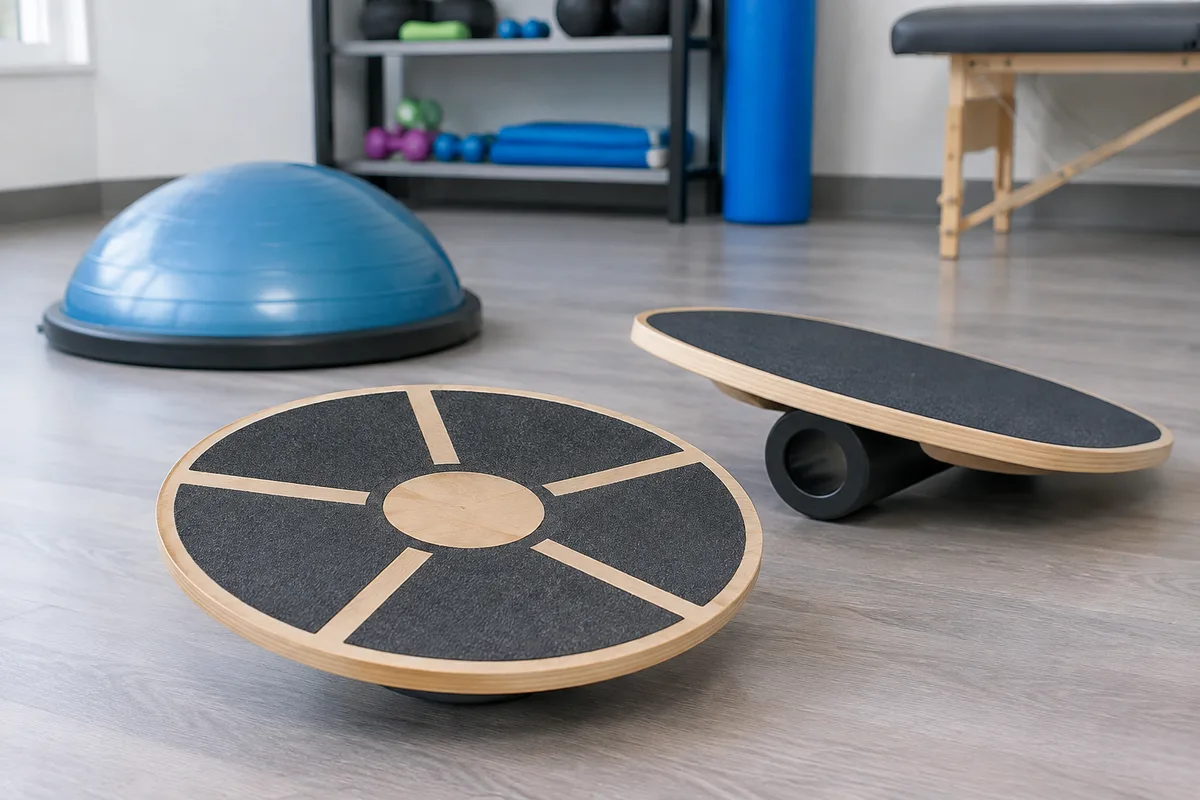
Balance boards, sometimes called wobble boards, are simple mechanical tools used to challenge and retrain the body's sense of stability. At Physical Therapy and Rehabilitation Center of Brooklyn, they are one of several hands-on tools used to help patients rebuild coordination, joint control, and confidence in movement.
What balance Boards is
A balance board is a flat platform set on a rounded or unstable base. Standing on it forces the ankles, knees, hips, and core to make small, constant adjustments to keep the body upright. This repetitive challenge trains the nervous system and muscles to react more quickly and accurately to shifts in weight and position — a skill known as proprioception.
Before tools like this were widely used, balance retraining relied mostly on static standing exercises or simple floor work. Balance boards add a controlled, adjustable element of instability, allowing therapists to grade the difficulty of an exercise as a patient's control improves, rather than jumping straight from a stable surface to an unpredictable real-world environment.
How we use it at Physical Therapy and Rehabilitation Center of Brooklyn
Balance boards are part of the on-site equipment used to support balance training, fall prevention, and rehabilitation after injuries affecting the ankles, knees, or hips. They are often introduced alongside other tools such as balance pads, exercise balls, and treatment tables, allowing a therapist to progress a patient from a simple, stable exercise to a more dynamic one as strength and coordination improve.
Because balance work depends on repetition and gradual progression, sessions using the boards are typically paired with supervised exercise so form and safety can be monitored throughout. This equipment is often used in the course of broader programs such as Balance Training, Fall Prevention, and Vestibular Therapy, where retraining stability is a central goal.
What it means for you
Working with a balance board can help patients regain a clearer sense of where their body is in space, which supports safer walking, standing, and daily movement. For many people, this translates into steadier footing on uneven surfaces, more confidence getting in and out of chairs or vehicles, and reduced reliance on external support during everyday tasks.
Because the difficulty of the exercise can be adjusted, the same tool can be used early in recovery, when balance is limited, and later on, when the goal shifts toward more demanding coordination and strength work. This flexibility can make balance training feel approachable rather than intimidating, regardless of where a patient is starting from.
What to expect during your visit
A session that includes balance board work usually begins with a brief warm-up and a check-in about how the affected area has been feeling. The therapist will typically stand nearby or offer hand support at first, especially for patients who are new to unstable-surface training or recovering from a recent injury or surgery.
During the exercise, you may be asked to shift your weight, hold a position, or perform small movements while standing on the board. Sessions on the board itself are usually brief — a few minutes at a time — and are often combined with other strengthening or mobility exercises using tools such as resistance bands, stationary bikes, or exercise mats. Afterward, many patients notice mild muscle fatigue in the ankles or legs, which is a normal response to the added coordination demand.
Frequently asked questions
Is using a balance board safe?
Balance board exercises are introduced gradually and supervised by a therapist, who adjusts the difficulty based on your current ability. Support such as a nearby wall, rail, or hands-on assistance is provided as needed, particularly when you are first learning the exercise.
Will it feel uncomfortable?
Most patients feel a sense of muscle engagement in the ankles, knees, and core rather than pain. If an exercise feels too difficult or unstable, your therapist can modify the setup or reduce the range of motion until you are ready to progress.
How often is it used during treatment?
This depends on your individual plan and the goals you are working toward. Balance board exercises may appear briefly within several sessions as part of a broader program that also includes other balance and strengthening tools.
Who is balance board training appropriate for?
Balance boards can be used across a range of ages and conditions, from athletes recovering from an ankle or knee injury to older adults working on fall prevention. Your therapist will determine whether this tool fits your specific needs and adjust the exercise accordingly.
If you'd like to learn whether balance board training could be part of your recovery plan, reach out to Physical Therapy and Rehabilitation Center of Brooklyn to ask about scheduling a visit.
This content is for general information only and isn't medical advice. Talk with a qualified provider about your own situation. If you have a medical emergency, call 911.